
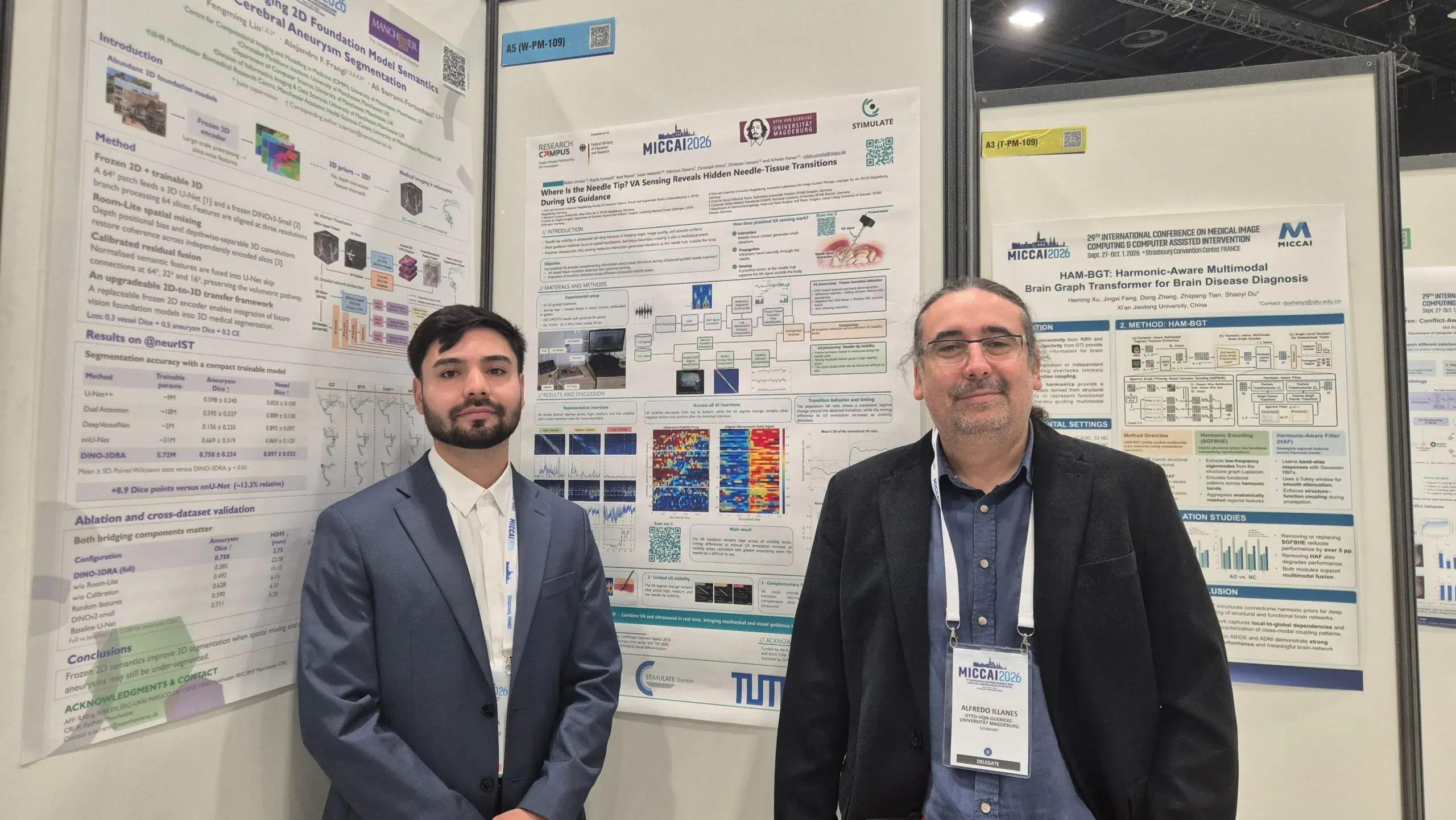
The VAR Group was represented at MICCAI 2026 by Robin Urrutia and Dr. Alfredo Illanes, who presented two papers on vibroacoustic (VA) sensing as a new source of information during minimally invasive procedures. One contribution was selected for an oral presentation in addition to its poster; the other was presented as a poster.
In “Where Is the Needle Tip? VA Sensing Reveals Hidden Needle-Tissue Transitions During US Guidance”, vibroacoustic sensing is used to detect tissue transitions during ultrasound-guided needle insertion. Vibrations generated by the interaction between needle and tissue are measured proximally at the needle hub and analyzed to identify when the needle crosses tissue boundaries. The results show that VA sensing can capture transitions that are difficult to identify with ultrasound alone, particularly when needle-tip visibility is limited, and can therefore provide complementary information for safer and more reliable needle guidance.
The second contribution, “When Tissue Speaks: Vibroacoustic Monitoring of Tissue Response During Electrosurgery”, explores vibroacoustic sensing during electrosurgical coagulation in laparoscopic procedures. It shows that tissue changes caused by electrosurgical energy produce measurable changes in the vibroacoustic signal. The results reveal characteristic signal dynamics during coagulation as well as differences between tissue types, which opens the possibility of monitoring tissue response during electrosurgery with vibroacoustic information – currently assessed mainly by visual observation.
Together, these two contributions demonstrate the broad potential of vibroacoustic sensing for needle guidance and laparoscopic procedures: information generated directly by the interaction between surgical instruments and tissue can complement existing sensing and imaging technologies.
We thank our collaborators from the Center for Digital Surgery, Department of General, Visceral and Pediatric Surgery, University Medical Center Göttingen; the Department of Otorhinolaryngology, Head and Neck Surgery, and Plastic Surgery, Justus Liebig University of Giessen; and Computer Aided Medical Procedures (CAMP), Technical University of Munich, whose collaboration contributed to this research.