This page lists the publications of our group in virtual and augmented reality, human–computer interaction, and image and signal processing. Browse our selected papers or the complete list, or use the search to find authors, titles and topics.
Sorry, no publications matched your criteria.
2013
1.

Wang, L; Hansen, C; Zidowitz, S; Hahn, H
Interactive Segmentation of Vascular Structures in CT Images for Liver Surgery Planning Proceedings Article
In: Proceedings of the Annual Meeting of the German Society of Computer- and Robot-Assisted Surgery (CURAC), pp. 98–102, Univ. Prof. Dr. Mag. Wolfgang Freysinger, Innsbruck , Österreich, 2013.
@inproceedings{wang_interactive_2013,
title = {Interactive Segmentation of Vascular Structures in CT Images for Liver Surgery Planning},
author = {L Wang and C Hansen and S Zidowitz and H Hahn},
url = {https://www.var.ovgu.de/pub/Wang_CURAC2013_Manuscript.pdf},
year = {2013},
date = {2013-01-01},
urldate = {2013-01-01},
booktitle = {Proceedings of the Annual Meeting of the German Society of Computer- and Robot-Assisted Surgery (CURAC)},
pages = {98–102},
publisher = {Univ. Prof. Dr. Mag. Wolfgang Freysinger},
address = {Innsbruck , Österreich},
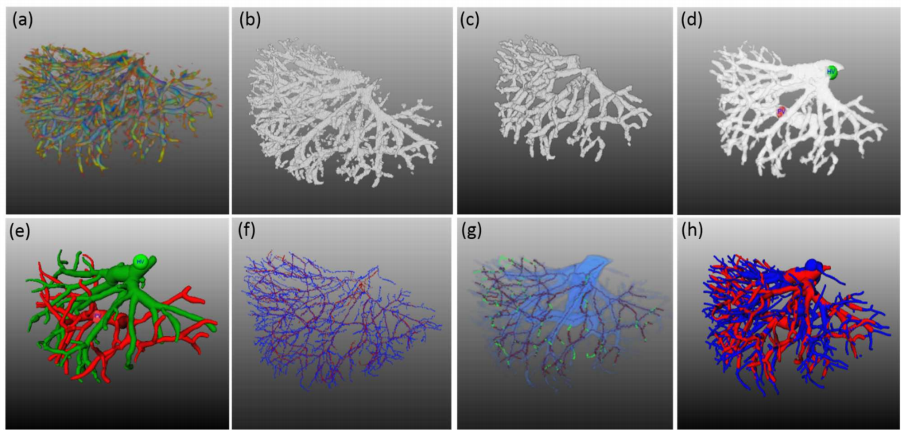
abstract = {Vasculature analysis based on CT images is indispensable in liver surgical planning and diagnosis of liver disease. We
propose a novel framework and efficient workflow with minimal user interactions to analyze liver vasculature in multi-
phase CT images. To ensure segmentation quality and efficiency, a set of semi-automatic algorithms are applied to initially
segment different vascular structures in different phase. A fully automatic vessel separation procedure runs parallel to
separately connected hepatic and portal veins. In addition, an interactive editing method is integrated into the framework
to refine the segmentation of each individual structure. Quantitative evaluations of segmented vessels conducted for 60
test data sets are demonstrated.},
keywords = {},
pubstate = {published},
tppubtype = {inproceedings}
}

Vasculature analysis based on CT images is indispensable in liver surgical planning and diagnosis of liver disease. We
propose a novel framework and efficient workflow with minimal user interactions to analyze liver vasculature in multi-
phase CT images. To ensure segmentation quality and efficiency, a set of semi-automatic algorithms are applied to initially
segment different vascular structures in different phase. A fully automatic vessel separation procedure runs parallel to
separately connected hepatic and portal veins. In addition, an interactive editing method is integrated into the framework
to refine the segmentation of each individual structure. Quantitative evaluations of segmented vessels conducted for 60
test data sets are demonstrated.
propose a novel framework and efficient workflow with minimal user interactions to analyze liver vasculature in multi-
phase CT images. To ensure segmentation quality and efficiency, a set of semi-automatic algorithms are applied to initially
segment different vascular structures in different phase. A fully automatic vessel separation procedure runs parallel to
separately connected hepatic and portal veins. In addition, an interactive editing method is integrated into the framework
to refine the segmentation of each individual structure. Quantitative evaluations of segmented vessels conducted for 60
test data sets are demonstrated.