Maximilian Schotte, B.Sc.
Publications
2026
Schwenderling, L; Schotte, M; Heinrich, F; Hansen, C
Augmented Reality Training of Attention Allocation in Medical Dual-Task Learning Applications Proceedings Article
In: The ACM International Conference on Mobile Human-Computer Interaction 2026 (MobileHCI 2026), 2026.
@inproceedings{nokey,
title = {Augmented Reality Training of Attention Allocation in Medical Dual-Task Learning Applications},
author = {L Schwenderling and M Schotte and F Heinrich and C Hansen},
doi = {doi.org/10.1145/3821716},
year = {2026},
date = {2026-08-31},
urldate = {2026-08-31},
booktitle = {The ACM International Conference on Mobile Human-Computer Interaction 2026 (MobileHCI 2026)},
journal = {The ACM International Conference on Mobile Human-Computer Interaction 2026 (MobileHCI 2026)},
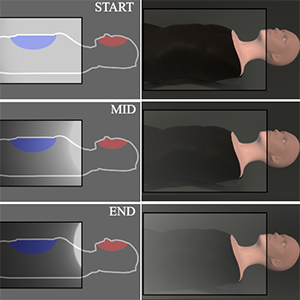
abstract = {Augmented reality (AR) has shown promising results in training for medical procedures. However, it can lead to attentional tunneling, where only the examination area is focused on. Observing the patient's face is an important part of medical examinations to detect signs of pain. To address this, four attention guidance cues were developed to complement medical AR training scenarios. Two visual cues, a subtle, mid-peripheral flashing and an overt circle segment, and two auditory cues, a spatial non-diegetic ticking sound and spatial diegetic breathing sounds, were implemented. In a mixed-design user study (n = 80), performance and gaze behavior were compared before, directly after, and one hour after training with the cues in a dual-task involving visual and haptic elements. Training significantly improved task performance for cue and control groups. Although no proposed cues individually differed significantly from the control group, cues overall, and auditory cues in particular, improved viewing behavior.},
keywords = {},
pubstate = {published},
tppubtype = {inproceedings}
}
Augmented reality (AR) has shown promising results in training for medical procedures. However, it can lead to attentional tunneling, where only the examination area is focused on. Observing the patient's face is an important part of medical examinations to detect signs of pain. To address this, four attention guidance cues were developed to complement medical AR training scenarios. Two visual cues, a subtle, mid-peripheral flashing and an overt circle segment, and two auditory cues, a spatial non-diegetic ticking sound and spatial diegetic breathing sounds, were implemented. In a mixed-design user study (n = 80), performance and gaze behavior were compared before, directly after, and one hour after training with the cues in a dual-task involving visual and haptic elements. Training significantly improved task performance for cue and control groups. Although no proposed cues individually differed significantly from the control group, cues overall, and auditory cues in particular, improved viewing behavior.
2025

Schwenderling, L; Schotte, M; Joeres, F; Heinrich, F; Hanke, L; Huettl, F; Huber, T; Hansen, C
Teach Me Where to Look: Dual-task Attention Training in Augmented Reality Proceedings Article
In: Proceedings of the Extended Abstracts of the CHI Conference on Human Factors in Computing Systems, pp. 1–8, ACM, Yokohama Japan, 2025, ISBN: 979-8-4007-1395-8.
@inproceedings{schwenderling_teach_2025,
title = {Teach Me Where to Look: Dual-task Attention Training in Augmented Reality},
author = {L Schwenderling and M Schotte and F Joeres and F Heinrich and L Hanke and F Huettl and T Huber and C Hansen},
url = {https://dl.acm.org/doi/10.1145/3706599.3720198},
doi = {10.1145/3706599.3720198},
isbn = {979-8-4007-1395-8},
year = {2025},
date = {2025-04-01},
urldate = {2025-04-01},
booktitle = {Proceedings of the Extended Abstracts of the CHI Conference on Human Factors in Computing Systems},
pages = {1–8},
publisher = {ACM},
address = {Yokohama Japan},
abstract = {Regular eye contact is essential in medicine to recognize signs of pain. However, it is difficult to remember this during training as attention is tied up in learning. While augmented reality (AR) has shown promising results for medical education, there is no training for attention allocation yet. Therefore, three auditory and three visual attention guidance tools in AR are evaluated for their use in medical dual-task training settings. In expert reviews with six participants in human-computer interaction and medical didactics, advantages, disadvantages, and refinements for the cues were developed. For visual cues, an overt but less occluding cue was preferred for constant visibility of the primary task. A more diegetic cue design was proposed for the auditory cues to use a patient simulation as a reminder of the regular face glance. In general, several cues were found to be suitable for gaze guidance training, requiring only minor changes for improvement.},
keywords = {},
pubstate = {published},
tppubtype = {inproceedings}
}

Regular eye contact is essential in medicine to recognize signs of pain. However, it is difficult to remember this during training as attention is tied up in learning. While augmented reality (AR) has shown promising results for medical education, there is no training for attention allocation yet. Therefore, three auditory and three visual attention guidance tools in AR are evaluated for their use in medical dual-task training settings. In expert reviews with six participants in human-computer interaction and medical didactics, advantages, disadvantages, and refinements for the cues were developed. For visual cues, an overt but less occluding cue was preferred for constant visibility of the primary task. A more diegetic cue design was proposed for the auditory cues to use a patient simulation as a reminder of the regular face glance. In general, several cues were found to be suitable for gaze guidance training, requiring only minor changes for improvement.